Showing posts with label Criterion Collection. Show all posts

Saturday, August 3, 2024

Only now does it occur to me... KUNG-FU MASTER (1988)

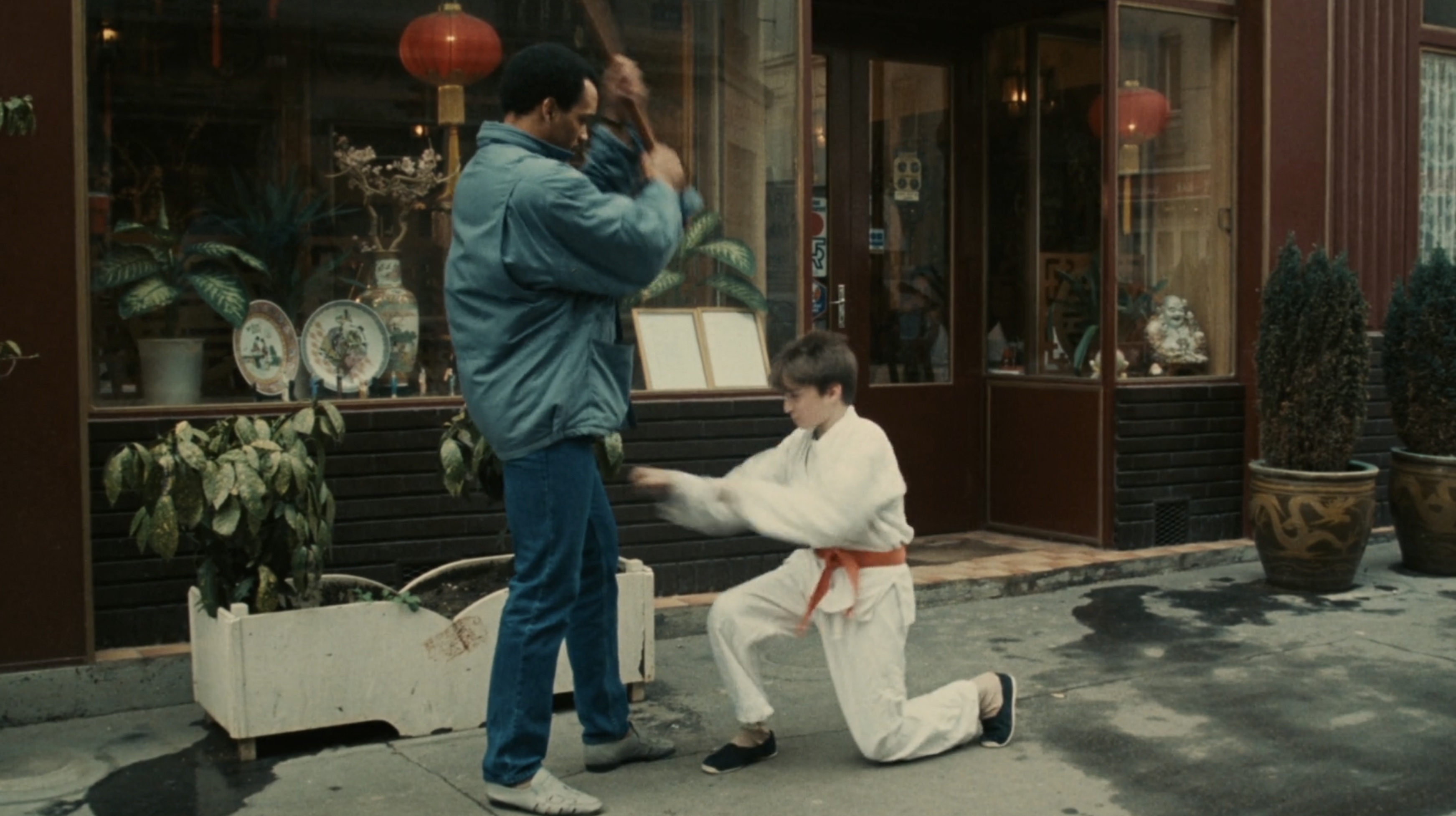
Only now does it occur to me... that I must tip my hat to noted cat lover and French New Wave scamp Agnes Varda for making the most accurate video game adaptation of all time. That she does it in a twisted arthouse bildungsroman starring Jane Birkin and Charlotte Gainsbourg makes it all the more remarkable.

In a brief segment, Varda––who, bar none, is my favorite nouvelle vague gremlin–– recreates the stilted, sidescrolling action of arcade classic KUNG FU MASTER (a.k.a. SPARTAN X and SVT)

in a live action fantasy, down to the awkward walking animation, the weird crouches, and the unwieldy controls.

A+. What I wouldn't give to see Agnes Varda's MS. PAC-MAN.

Sunday, August 7, 2022

R.I.P., Clu Gulager

This one hurts. Clu first came to my attention as "Lee" in Don Siegel's THE KILLERS, where his vicious calm and truly inspired acting choices made such an impression that I was compelled to seek out as many of his films as I could get my hands on. 

First, it was the easiest ones to find––like THE RETURN OF THE LIVING DEAD, THE LAST PICTURE SHOW, A NIGHTMARE ON ELM STREET 2: FREDDY'S REVENGE, WINNING, or MCQ; and then it was the rarities––staying up late to catch IRONSIDE, WALKER, TEXAS RANGER, and MURDER, SHE WROTE reruns, or buying old dog-eared videocassettes of WONDERLAND COVE/a.k.a. STICKIN' TOGETHER and THE WILLIES and HUNTER'S BLOOD and THE INITIATION. Recently, I'd been overjoyed to see him reaching new audiences with bit parts in Sean Baker's TANGERINE and Tarantino's ONCE UPON A TIME IN HOLLYWOOD.

His work is magnificent, no matter the context; in turns it can be morbid, melancholy, rugged, or hilarious. I saw him sow deep, satisfying empathy across a rogues' gallery of murderers, abusers (THE GAMBLER, among others!), and perverts (TAPEHEADS, among others!). There's his wonderfully macabre work with his departed wife Miriam Byrd-Nethery in FROM A WHISPER TO A SCREAM, creating a very human monster who bleeds pathos and induces in the viewer something approaching a somber state of agony. In each role he is intensely connected achieves a shocking level of intimacy; in each role he captures something that is true. Even in the films where he given nearly nothing to work with, like COMPANY OF KILLERS.

Then, I discovered Clu as a filmmaker. I saw the haunting and poetic A DAY WITH THE BOYS (available on the Criterion edition of GEORGE WASHINGTON and nominated for the short film Palm d'Or at Cannes), a film that wrests the viewer from reality and into a dream-space, one that's frightening and powerful. I saw several of the shorts he collaborated on with his family for their legendary acting workshops, read about the struggles of FUCKING TULSA (an incomplete film I dearly hope to have the opportunity to see one day), and got many kick from his son John Gulager's lovably demented horror features from the past decade (which are truly Gulager family affairs––films like the FEAST trilogy and PIRANHA 3DD). The entire family's work is infused with a fearless Grand Guignol sensibility and an infectiously gleeful streak of sadism, but it grapples with something larger and darker and more mysterious. In their incredible story, I see the anguish of life's stumbling blocks and I see the joy of what compels human beings to create. Clu and his family are soldiers of cinema, in the Herzogian sense.

PS–– For more context, I also highly recommend this piece about the Gulager clan (Clu, his wife Miram Byrd-Nethery (R.I.P.), his sons Tom and John, and daughter-in-law Diane Ayala) which first appeared in L.A. Weekly in 1997.

Wednesday, April 26, 2017

Only now does it occur to me... LOST IN AMERICA (1985)

Only now does it occur to me... that a throwaway line in Albert Brooks' road-trip satire may have influenced the TERMINATOR franchise.

During a brief exchange between Brooks, Julie Hagerty, and a motorcycle cop (that ends with a ticket being avoided due to a mutual appreciation of EASY RIDER), Brooks says:

"Did you see THE TERMINATOR?" 


–"No, I didn't. Heard about it, though."


"You should see it. You look like him."


"Thank you."

Now, since LOST IN AMERICA was made in 1985, Brooks must be referring to Cameron's original TERMINATOR (from 1984), drawing a humorous comparison based on the cop's demeanor and sunglasses, comparing him to Arnold Schwarzenegger's titular character. However, while the cop doesn't actually resemble Arnold in any meaningful way, he is a dead ringer for Robert Patrick's motorcycle cop-impersonating T-1000 in TERMINATOR 2: JUDGMENT DAY...

...which was not released until six years later, in 1991. So maybe James Cameron was watching LOST IN AMERICA when he decided he needed a motorcycle cop Terminator? Or perhaps Brooks is referring to Patrick, whom he glimpsed in a time-traveling VHS copy of TERMINATOR 2. (Which must have been the splitting point for the Berenstain Bears parallel universe.)

Friday, March 3, 2017

Only now does it occur to me... THE MANCHURIAN CANDIDATE (1962)

Only now does it occur to me... that THE MANCHURIAN CANDIDATE (1962) has much to offer viewers in 2017, whether it is the perfect metaphorical image of an American flag composed of three types of caviar:

or the "Manchurian Candidate" himself, Senator John Iselin (James Gregory), a blunt, vulgar, and simple-minded instrument of Machiavellian operators (including Angela Lansbury)


who, despite being the most transparent of bullies and liars, is widely regarded as a harmless buffoon with a particular flair for riling up the intelligentsia.


Perhaps, ultimately, it is worth remembering that the Manchurian Candidate––a man who craves the spotlight and the illusion of power, no matter the cost and consequence, no matter the motives of his brutish handlers and willful enablers, a man who reduces every argument to 'us versus them' and appears incapable of deep and critical thought––this is a man who disgusts even those who regard him as a useful fool or a muscle to be flexed. In some ways, he is a tragic figure, tragic like the termite who chews through the support beam that destroys his nest, tragic like the energy magnate who befouls a world his grandchildren must inherit, tragic like the oversized child who douses his steak in ketchup while playing at sophisticate.


Thursday, January 12, 2017

Only now does it occur to me... HARD BOILED (1992)

Only now does it occur to me... that John Woo is not merely a master of action, but a master of "character exposition." Within the first twenty-eight seconds of HARD BOILED, we learn everything we need to know about Chow Yun-Fat's "Inspector Tequila."

First, we learn that his favorite beverage is the "Tequila Slam," which is apparently a real thing. That would be "well tequila" (the kind that only occasionally comes in a glass bottle),

and seltzer water

covered with a paper napkin and slammed against the bar––a maneuver that is perhaps intended to showcase the performative "badass fizz" aspect but as a result spills nearly half the drink; it is satisfying perhaps to Inspector Tequila in the moment, but something of an inconvenience for a neat-freak bartender.

Amazingly, this is a fitting analogy for Inspector Tequila's fearlessly stylish-yet-sloppy methods of policework. (Though it is less elegant than the "Travis Bickle calmly stares at his own alka-seltzer while quietly boiling on the inside" scene in TAXI DRIVER, this is from the director who first brought us JCVD punching a snake, so let's cut him some slack.)

Anyway, Inspector Tequila knocks back the drink,
sets it down, and slides––in one fluid movement––back to a stool on a stage,

where he proceeds to play a mean jazz clarinet. John Woo seems to say, "Inspector Tequila is a rough-and-tumble individual, but he has a soft side––as velvety smooth as a clarinet playing 'Sweet Georgia Brown' at an Elks Lodge in Missoula, Montana for a crowd of slow-dancing geriatrics."
But this ain't no Elks Lodge in Missoula––these are the mean streets of Hong Kong, circa 1992, as could only imagined by John Woo's slo-mo bullet-ballet-addled brain!

Let's move ahead three minutes in time. See those two guys, Inspector Tequila?

The ones with the bird cages?

If you, as an audience member, at first glance, don't make the assessment that yes, those bird cages are probably filled with guns, then you, my friend, are watching the wrong movie.
Inspector Tequila is an astute observer of the human animal, unlike yourself.

All of this is essentially a set-up for over two hours of two-fisted acrobatic gunplay and incredible non-union stuntwork,
all in Woo's distinctive "Peckinpah-meets-Shaw-Brothers-meets-screwy-Jean-Pierre-Melville" style, which went on to birth THE MATRIX, Robert Rodriguez, and any number of contemporary action films and directors.

I love HARD BOILED. I love typing the words "Inspector Tequila." And perhaps most of all, I love this nearly three minute long shot that involves so many moving parts, actors, stuntmen, and explosions, that it defies reason:

Sunday, January 24, 2016

Film Review: THE BROOD (1979, David Cronenberg)

Stars: 5 of 5.
Running Time: 92 minutes.
Tag-line: "The Ultimate Experience Of Inner Terror."
Notable Cast or Crew: Oliver Reed (THE DEVILS, WOMEN IN LOVE, SITTING TARGET), Samantha Eggar (DOCTOR DOLITTLE, THE COLLECTOR, THE EXTERMINATOR), Art Hindle (INVASION OF THE BODY SNATCHERS '78, PORKY'S), Cindy Hinds (THE LITTLEST HOBO, THE DEAD ZONE), Susan Hogan (DISTURBING BEHAVIOR, THE LITTLE VAMPIRE), Robert A. Silverman (SCANNERS, NAKED LUNCH), Henry Beckman (MARNIE, DEATH HUNT).  Produced by Pierre David (VISITING HOURS, SCANNERS, VIDEODROME).  Cinematography by Mark Irwin (SCREAM, ROBOCOP 2, VIDEODROME).  Music by Howard Shore (AFTER HOURS, THE LORD OF THE RINGS).
Best One-liner:  "Thirty seconds after you're born you have a past and sixty seconds after that you begin to lie to yourself about it."

"THE BROOD is my version of KRAMER VS. KRAMER, but more realistic."   –David Cronenberg

"You got involved with a woman who fell in love with your sanity and hoped it would rub off."  –"Frank Carveth," a character in THE BROOD

What better time than a blizzard for this icy Canadian horror psychodrama?  It's David Cronenberg's THE BROOD!

In this, his fourth theatrical feature (though it's actually his twenty-first film, if we include his shorts and television work), Cronenberg gets personal––really personal.  Specifically, he delves into the intimate and troubling emotional landscape of his divorce and the subsequent custody battle.  My impression is that the artistic process must have been so draining and generally unnerving that he would require years to recover––in fact, SCANNERS, his 1981 follow-up, unfolds at such a passive, Kubrickian remove, that I would go so far as to call it his most impersonal film.  Perhaps using cinema as a tool for psychological self-analysis in THE BROOD felt a little too much like toying with the "new flesh," like something out of the Philip K. Dick novels Cronenberg idolized as a young man and would later deconstruct and reassemble as frightening, post-modern, sterile techno-hellscapes (SCANNERS, VIDEODROME).

Did he fear becoming one of the half-benevolent, half-mad techno-sages that pepper his films (like Oliver Reed's "Hal Raglan" in THE BROOD, Patrick McGoohan's "Paul Ruth" in SCANNERS, or Jack Creley's "Brian O'Blivion" in VIDEODROME)?  I've always thought the greatest horror writers are the ones fully capable of scaring themselves––and so we enter the world of THE BROOD.

Oliver Reed plays the aforementioned Dr. Hal Raglan, a techno-guru whose new methodology, "Psychoplasmics," attempts to physically manifest emotions like resentment, melancholy, and rage within his patients.

The film imagines the following scenario: what if discontent could be grown externally, like a sore or a lesion? Would people perceive mental illness differently? Could it be treated simply and painlessly? Perhaps the fallout from a bad job, bad marriage, bad childhood, or bad life could be frozen, disintegrated, and forgotten as easily as a wart or a blister.

The opening scene involves a public presentation of Psychoplasmics, and it is well on par with the infamous demonstration from SCANNERS (if not as Grand Guignol). It's a simple interaction between doctor and patient (Oliver Reed and Gary McKeehan), but Cronenberg's execution is fresh and hypnotic.  There is a distinct performative, theatrical aspect, but also an uncomfortably intimate one.  In the context of the film and behind the camera, the layers of staging and representation are as poignant as they are disquieting.


You might occasionally chuckle at the intensity of the performances, but only in the way you might whistle, wide-eyed and skittish, through a graveyard at night.

I don't want to tell you too much about THE BROOD.  I think it's a sci-fi horror film that's sadder than it is scary (quite an achievement, because it is incredibly unnerving), and it really toes the line between Body Horror and Melancholy Horror.  It is a film about cycles of abuse, the reverberations of divorce, and the repression of emotional scars. It is a film about how psychological damage inevitably resurfaces, no matter how deeply it is buried.  And yet it is also a film about damage extracted from the soul––scrutinized, treated, and compartmentalized––and how it, despite our best efforts, may very well resurface, too.

On a slightly lighter note, I'll close out the review with a few stray observations (without spoiling THE BROOD).


#8.  Let's talk a little more about Oliver Reed.  The man was known to phone in (from the bar, to be specific) many of his performances (usually in genre fare) from the late 1970s and beyond.  That's not the case here.  I'm not sure I've seen him this committed and connected outside of a Ken Russell film.

Out of all of Cronenberg's techno-sages, Reed's is the only one who truly lays claim to a full story arc, and the bulk of that rests in his performance.  For instance, I can't think of many actors who can project "blind arrogance" and "reflective self-doubt" simultaneously, or with such panache.


#7.  Samantha Eggar.

I'm not so familiar with Samantha Eggar's catalog, but when I see that her most-viewed credits involve films like DOCTOR DOLITTLE and Walt Disney's HERCULES, I'd say that her talents have been under- or mis-used.  In THE BROOD, she is magnificently intense and eerily authentic.  She's only in a handful of scenes, but, ohhhh boy, does she make her mark.  At once she is the storm and the storm's eye; a dormant volcano, biding her time.  


#6.  And, by virtue of their intensity, this brings us to "Oliver Reed vs. Samantha Eggar,"


who in a number of scenes engage in one-on-one "scary eye" combat.

This is, in essence, why I go to the movies.


#5.  Art Hindle.

He's servicable, but not particularly colorful. In early Cronenberg films, the heroes tend to be blanker slates (see: Hindle here, or Stephen Lack in SCANNERS), and I'm not sure if this changes due to maturations in Cronenberg's writing or in his casting.  After SCANNERS, his heroes become far more memorable––James Woods' wondrous sleaze in VIDEODROME, Christopher Walken's spooky quirkiness in THE DEAD ZONE, Jeff Goldlum's lovable verbosity in THE FLY, Jeremy Irons' glum freakiness in DEAD RINGERS...


#5. This is peculiar: at one point, a policeman's (incorrect) theory about what's actually going on describes the plot twist of Dario Argento's PHENOMENA. Maybe Dario saw this at the movies and figured it was a red herring too good to pass up!


#4.  Mark Irwin's crisp, sterile, and foreboding cinematography.  You could chalk it up to the natural visuals of 1970s Canadian architecture or the way the overcast Ontarian light strikes the lens, but Cronenberg and DP Mark Irwin (VIDEODROME, THE FLY, SCANNERS, THE DEAD ZONE) are clearly a match made in heaven.  Or perhaps hell.  Or more accurately, perhaps the waiting room to a body-horror clinic at the icy inner circle of hell.


And naturally, it has the requisite "little girl in a horror film wearing red" (á la DON'T LOOK NOW, et al.).


 #3.  With his second film score, Howard Shore has not quite yet come into his own––here, he's channeling Bernard Herrmann, and is more melodramatic than usual.  (It is solid work, though derivative.)  In the six years following THE BROOD, he will go on to compose SCANNERS, VIDEODROME, and AFTER HOURS––three of the finest and most original soundtracks of the 1980s.


#2.  Hey, it's Robert A. Silverman!  One of the key "Cronenberg Cronies," he's lent his oddball, off-kilter presence to classics like RABID, SCANNERS, NAKED LUNCH, eXistenZ, and even Cronenberg's episode of FRIDAY THE 13TH: THE SERIES.

Here, he has a, um––shall we say, "neck condition?"


#1.  Cindy Hinds, a child actor with serious chops.

A bad performance here would have wreaked serious consequence on the rest of the film, but Ms. Hinds (who also appears in THE DEAD ZONE) is capable of adapting to very subtle changes in tone, at times displaying a frightening detachment or a traumatized vulnerability.

She is perhaps the true center of this film, an open-ended enigma whose fate, depending on your own emotional state, can be unwritten or preordained.

Five stars.


––Sean Gill