Stars: 3.8 of 5.
Running Time: 106 minutes.
Notable Cast or Crew: Asia Argento (MOTHER OF TEARS, THE LAST MISTRESS), Christopher Rydell (ON GOLDEN POND, MASK), Piper Laurie (TWIN PEAKS, CARRIE), Frederic Forrest (APOCALYPSE NOW, FALLING DOWN), James Russo (MY OWN PRIVATE IDAHO, THE NINTH GATE), Brad Dourif (CHILD'S PLAY, ONE FLEW OVER THE CUCKOO'S NEST). Gore by Tom Savini (DAWN OF THE DEAD, FRIDAY THE 13TH). Music by Pino Donaggio (CARRIE, BODY DOUBLE) and Andrea Bandel.
Tagline: "A new dimension of fear."
I can sum this one up for you in just two words: "Minnesotan Giallo." I could probably make the argument that this is Argento's last great film (before they became at best, mediocre, and, at worst, money-laundering operations), but with a movie this ludicrous, that's probably a meaningless distinction, and I could easily say the same for OPERA (1987) or SLEEPLESS (2001). Nonetheless, I apparently like TRAUMA a lot more than most people do.
Based on screenplay co-written by Dario Argento, T.E.D. Klein (one of the great, underappreciated horror writers of the 1980s, whose novel THE CEREMONIES is an all-timer), Franco Ferrini (PHENOMENA, ONCE UPON A TIME IN AMERICA), Gianni Romoli (producer of CEMETERY MAN), and Ruth Jessup (production secretary on EVIL DEAD II), TRAUMA is a delicious slice of You Betcha Message-Movie madness where the twin cities are, apparently, Minneapolis and Rome (feel free to insert a St. Paul/St. Peter's Basilica joke here).
Like most of Argento's gialli, the plot has plenty of twists and turns, a satisfying/relatively surprising payoff, and notably (that is, for the thriller genre at large, not for Argento), one that holds up to repeat viewings and doesn't cheat the audience. See also: DEEP RED and TENEBRE, who also hide their Big Secrets––like Poe's purloined letter––out in the open, if we care to look.

Also like most Argentos, TRAUMA has a black-leather-gloved killer, well-choreographed murders, stylized gore, avant-garde POV shots, childhood trauma, uncomfortable family member nudity, bizarrely specific animals and/or insects being instrumental to the plot, and more than a few nonsensical (Eurotrash) grace notes. New for Argento are the American milieus (though his segment of TWO EVIL EYES was also shot in the States), a semi-understated De Palma-lite orchestral score by Pino Donaggio (instead of his usual Goblin/Simonetti music), and the decision to make this a "Message Picture." (More on that in a minute.)
I'll attempt to guide you through the joys and bafflements of all this TRAUMA without giving any significant spoilers–– so, without further ado––grab your lutefisk, Vikings jerseys, and dopey ear-flap'd trapper caps, cause dontcha know we're about to delve into My Top Ten Minutiae for Argento's TRAUMA:
#10. Americana.
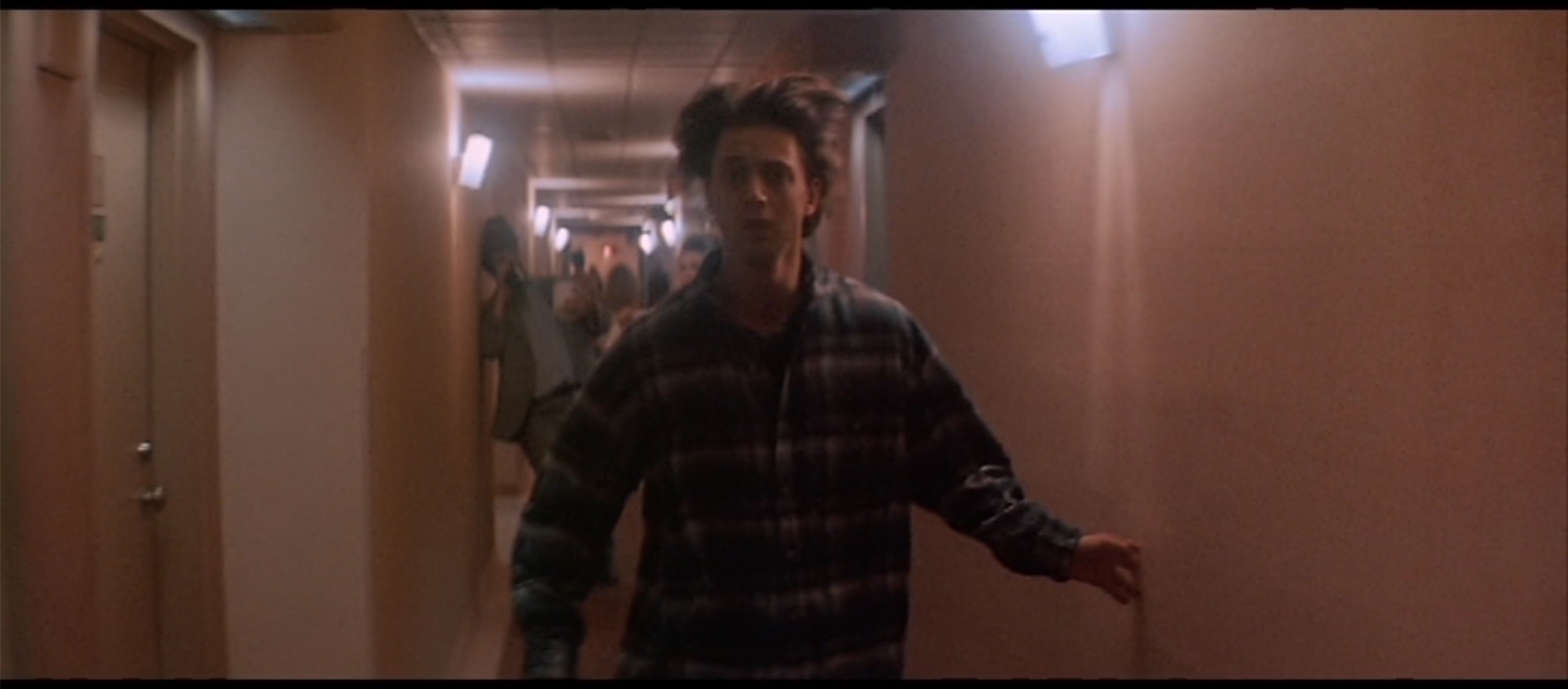
Argento is so clearly taken with/horrified by what the ol' U.S. of A has to offer that he can't bear to look away. In a hotel hallway scene, it's the drunken man in the background in a Shriner cap:

In a corporate diner, it's what passes for food:

It's the parking lots:

The concrete architecture and pick-ups with fiberglass truck caps:

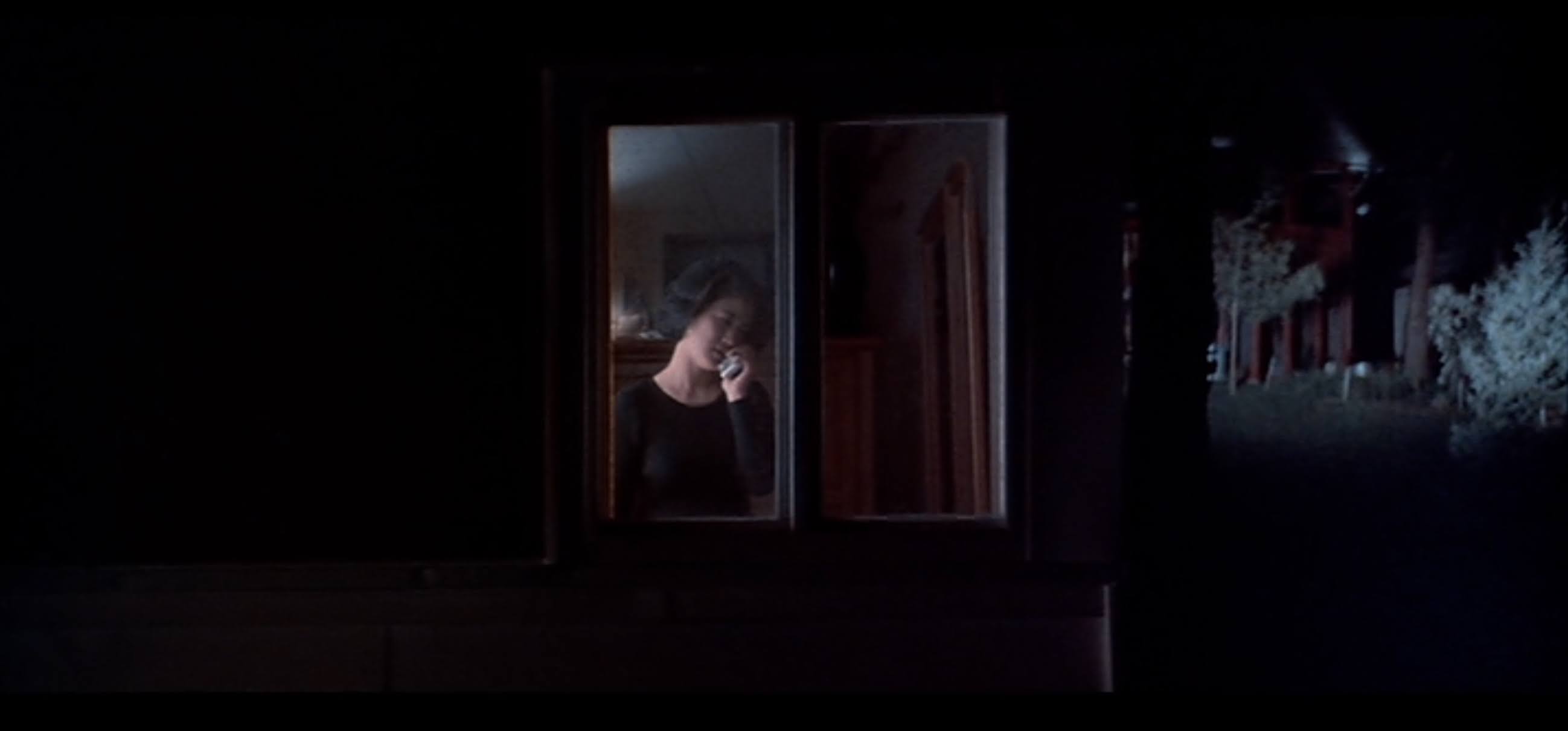
And, finally, in what I can only assume is a moment inspired by Argento's first confusing stay in a corporate American hotel, we see the victim unable to fight off the killer at a crucial moment because the room's lamp is screwed to the table

instead of being loose and easily removable––as it apparently should be––for defending against black-gloved, hammer-wielding murderers:

#9. The Message Picture Angle.
Hoo boy, here we go. Asia Argento––Dario's daughter––plays one of the film's dual protagonists. Having witnessed the murder of her parents, she has acquired a number of problems. From the filmmakers' point of view, the most important of these is an eating disorder. You see, she binges and purges.


This, as we all know, is not a cartoonishly simplified, textbook case of bulimia, but rather––according to Dr. Dario Argento and every character in the film––"anorexia."

That's right: Argento decided to make a Message Picture about overcoming an eating disorder and proceeded to misidentify the disorder. To those who are not lifetime aficionados, this is the most Argento thing he could possibly do. In Dario Argento's MONK, Tony Shalhoub would express every symptom of OCD, but they'd call it multiple personality disorder. In Dario Argento's TRAINSPOTTING, Ewan McGregor would spend half the movie shooting up heroin but they'd call it a gambling addiction. This is, obviously, incredible. For instance, Argento would rather put way more time, effort, and detail into something like
#8. Butterfly P.O.V.

It's a dizzying scene, completely unnecessary, and yet it's a perfect moment of Pure Cinema.
#7. But Wait, I'm Not Done Talking About the Message Picture Angle.
Oookay, so he keeps going. There are lengthy monologues and montages about "anorexia" which flirt with absurdity,

interrupted by images of sad, skinny women on the streets of Minnesota who may not even know what they're being filmed for

as the "symptoms of anorexia" get weirdly specific (every person with anorexia is deeply attached to an unstable mother?)

Oh, did I say "flirts with absurdity?" I meant, "dates absurdity, marries absurdity, purchases a burial plot beside absurdity..."


Err––WHUT? Let's not ponder that last one too deeply.
#6. Christopher Rydell's bland "David Parsons." The secondary protagonist is a mopey dude who makes a living as a horror sketch artist for a local Minneapolis news station.


Huh. Didn't know that was a real, full-time job. Guess I'll defer to the expert on such matters: Dario Argento.
Even though he's an American who has been featured in such films as MASK, GOTCHA, HOW I GOT INTO COLLEGE, and ON GOLDEN POND, Argento pulls a pouty, Eurotrash performance out of him. He sorta reminds me of Marco Gregorio ("Trash" in Enzo Castellari's 1990: BRONX WARRIORS).

He's a grown man with this sketchy day job and a pretty normal life and a newscaster girlfriend until he meets up with Asia's teenage runaway "Aura" and decides to let her move in with him. (Ostensibly, it's because he also has struggled with drug problems––oh yeah, did I mention that Asia's character is also a heroin addict? That's mentioned once and then buried beneath a lot of bulimia––but the whole thing feels a little creepy.) He wears the kind of 90s outfits you'd see on Chandler from FRIENDS. Oh, hey, look, there's a Chi-Chi's in the background.

That'd be a good trivia question: in which Dario Argento film is there a Chi-Chi's? This one.
#5. Brad Dourif!
He has a bit part here as a former doctor going through a midlife crisis, and he's got the six-day stubble and gold chain/earring combo to prove it. He gives his role some sleaze, some comedy, and some pathos.

He, or his agent, must have insisted on the strange credit of "special appearance by."

It's only weird because there are other, well-known character actors of similar caliber and with a similar amount of screen-time. Actors like...
#4. Piper Laurie!

As an Eastern European psychic and Asia's on-screen mother, Piper offers us shades of CARRIE while hamming it up and laying on a thick Romanian accent.

As always, she's fantastic. Horror royalty in this household. Royalty, I say.
#3. And Frederic Forrest. Another oddball American character actor/Oscar nominee being used very effectively.

That's right, there are three Oscar nominees in this movie. It's a shame that Argento's association with great American character actors pretty much dried up post-1993 (are we counting Steven Weber in JENIFER? No, no we are not), cause they really deliver some earnest post-giallo seasoning to the proceedings here.
#2. Meta-Argento. He gets extremely self-reflexive in TRAUMA. To name a few moments, there is sudden and creepy pre-murder doll placement, as in DEEP RED:

(As a whole, it's very DEEP RED-influenced, from opening with a "séance gone wrong" to using the earlier film's bloody finale as a sly inspiration for the murderer's preferred instrument here.)
Hand-acting by Argento, which can be morbidly comic when things aren't going as smoothly as the murderer would prefer (as in DEEP RED, TENEBRE, OPERA, and elsewhere):

A domestic murder which thematically and literally recalls the iconic, extended crane-shot setpiece of TENEBRE (as well as the nature of the victims):

Impassive animal witnesses to murders, as in PHENOMENA, THE BIRD WITH THE CRYSTAL PLUMAGE, FOUR FLIES ON GRAY VELVET, and elsewhere (here, it's a gecko):

Impromptu, macabre paper dolls, as in DEEP RED:

And a random child learning more about the murderer (and earlier) than any other character, which is certainly a post-SHADOW OF A DOUBT ur-Hitchcockian idea which lies at the root of many of Argento's films.

That the child in question closely resembles Macaulay Culkin is simply a reminder that this movie was made in 1993.
#1. Reggae Dance Party.


Without spoiling the end of the picture, I will tell you this: it concludes with a reggae concert/dance party on a suburban Minnesotan porch. The lead dancer is, I believe, one of the skinny girls from the earlier street montage. What this is all meant to indicate is, at best, unclear. But who are we to question the maestro's judgment?

 Stars: 3.8 of 5.