Friday, October 27, 2023

Only now does it occur to me... PHANTASM II: THE BALL IS BACK (1988)

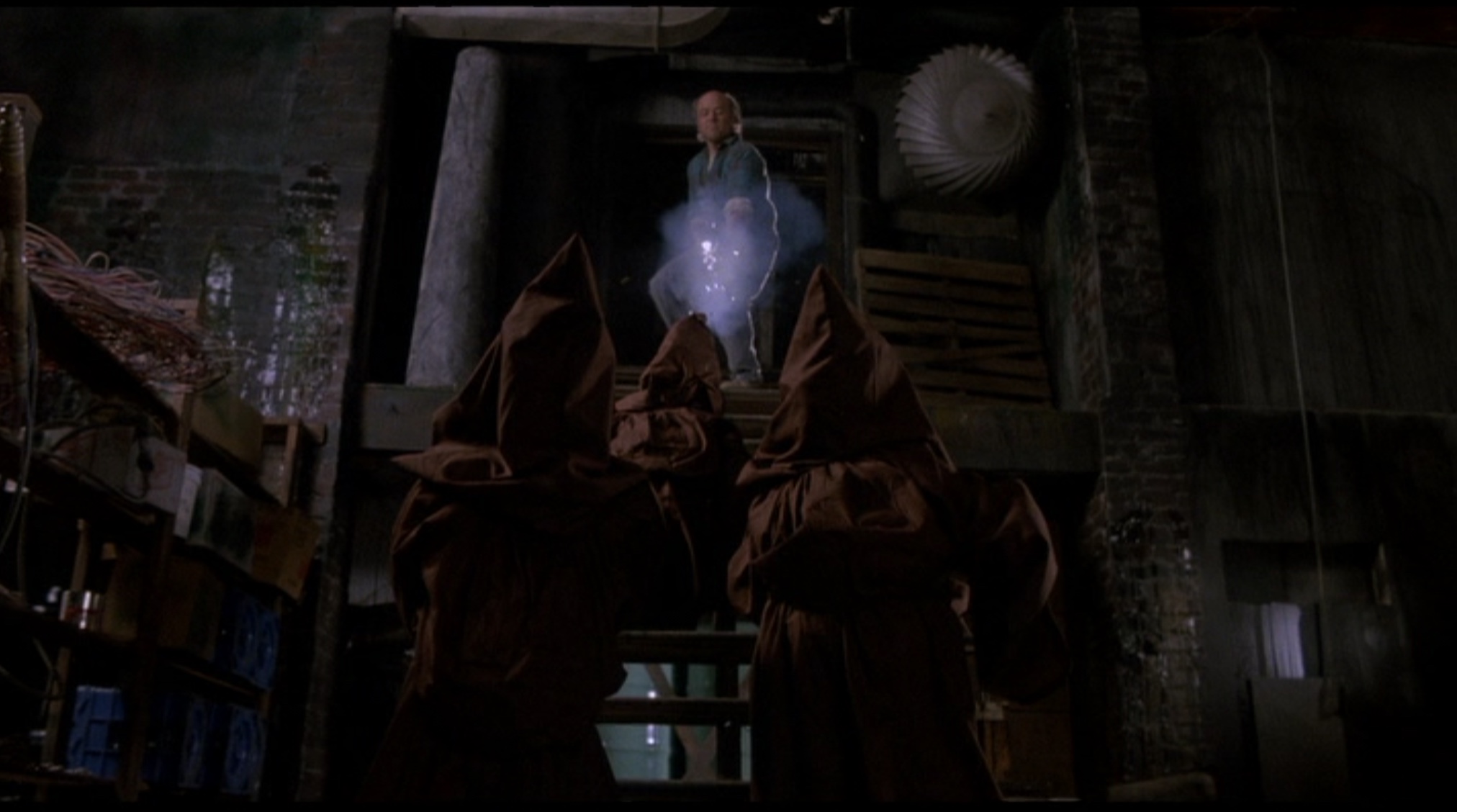
Only now does it occur to me... is PHANTASM II (1988) good? I thought so, back when I saw it for the first time, about fifteen years ago.


The budget is ten times larger (at $3 million) than PHANTASM's, and Universal Pictures put its major studio heft behind it (though it was the cheapest movie that Universal produced in the 1980s and generally feels like an upper-tier New World Picture). 

The Greg Nicotero and Robert Kurtzman SFX are solid,


 and the cinematography by Daryn Okada is crisp and impressive. 


They've changed up the essential formula from melancholy horror to sci-fi actioner, and it's somehow the median point between EVIL DEAD 2, ALIENS, and TEXAS CHAINSAW MASSACRE 2 on the "horror sequel reinvention" scale. Maybe it's the RETURN TO SALEM'S LOT of PHANTASM sequels?

In the lead role of "Mike," indie child actor A. Michael Baldwin has been upgraded (?) to '80s-'90s standby James LeGros (POINT BREAK, DRUGSTORE COWBOY) who basically plays him as THE EXTERMINATOR.


Slow-jammin' Ice Cream Man Reggie Bannister is back, baby,


as is Angus Scrimm, who is always a sobering, dangerous presence and, as the "Tall Man," wears the scariest bob haircut of all time. 


The sentinel sphere gang even gets a new member, in the form of a gold-plated, lightsaber-laser-wielding (?) video-game-boss-looking gadget. 


This movie features a four-barreled shotgun, for godssakes. 


There are a lot more explosions per capita, that's for sure.

Does this mean the movie is good, though? Not precisely. It doesn't have the craftsmanship or sheer adrenaline (or budget) of ALIENS, the satire of TEXAS CHAINSAW MASSACRE 2, or the comedy of EVIL DEAD 2––though we do get one of the most ludicrous sex scenes of all time with Reggie the Ice Cream Man ("You're a bald, middle-aged former ice cream vendor," says LeGros' Mike) cavorting with a mostly unexplained hitchhiking fashion model, in a scene so gratuitous that Reggie Bannister's actual wife insisted on being on set, just out of frame, for the duration. 


The actress playing the hitchhiker––Samantha Phillips––cannot keep a straight face throughout, possibly due to the proximity of Reggie's wife, and her unabashed mockery of the scene almost reclaims it from the male gaze. If this film offers Reggie as a sex symbol (and he plays it... like Clint Howard doing James Bond?), Samantha offers, through her performance, a sly retort.

While watching the film, I, too, had something like a dumb grin on my face for much of the duration––it's a movie that feels like it shouldn't exist, as if it were inexplicable, higher-budget fan fiction of an obscure indie. It's chock full of references for genre nerds, like Alex Murphy's grave (Peter Weller from ROBOCOP)


 or a bag full of Sam Raimi's ashes 


(as well as some Raimi-inspired POV shots 


and an arch moment of self-amputation). 


There's a weird whiskey priest subplot that goes nowhere, extended chainsaw duels, 


rat-exploding lasers,


and the poetic use of "Suck on this!" as a third-act one-liner.


In the end, this is all more of a curiosity than a genre classic, but I suppose I'm glad that it exists? It seems that for most PHANTASM "phans," they either love part 2 and dislike part 3, or they dislike part 2 and love part 3. As you will soon see, I'm much closer to being in the latter camp.

To be continued...

Tuesday, October 24, 2023

Only now does it occur to me... PHANTASM (1979)

Only now does it occur to me...  I've written a little about PHANTASM (1979) a few times before. It's a surrealistic indie melancholy horror which owes more to Luis Buñuel and Jean Cocteau (and a little Ray Bradbury) than, say, NIGHT OF THE LIVING DEAD or the Universal horror classics.

Fred Myrow's spooky-rockin' soundtrack. The yellow blood. The Jawa-men. The box of pain (a DUNE homage?). That sleazy lean-to shack-bar that looks like a stiff wind could blow it over. The noiseless, alabaster-white corridors of the mausoleum. The angry red sky of the other dimension. The phantasm balls, and their hidden secrets. The Tall Man. "BOYYYYYYYYY!"


Few films build such a wonderful impression of the end of summer and the beginning of autumn. Ultimately, it's a grim coming-of-age, and minus the supernatural elements, I think that its honesty and sheer quality should have even made the establishment critics take notice. In fact, Coscarelli's first two films were slice-of-life coming-of-age pictures played straight (the excellent KENNY & CO. and JIM, THE WORLD'S GREATEST). But let the establishment have their films, and let genre fans have PHANTASM. 


And despite all of its wonderful bells (and balls) and whistles, it all really comes down to a feeling, an emptiness, a melancholy born of grieving. That secret urge to wander the graveyard on an overcast day, and see what you can see...


I also once wrote about THE OTHER (1972) as the missing link between SOMETHING WICKED THIS WAY COMES and PHANTASM, but I'd like to add a few new observations as well. 


First, that it's incredible how deeply PHANTASM aligns––more psychically than literally––with STAR WARS. Both take deep inspiration from DUNE (STAR WARS with Tatooine, the Tusken Raiders, spice-running, Jedi spirituality, and the Butlerian jihad reflected in "we don't serve their kind here," etc.; PHANTASM with the faux-Bene Gesserit "put your hand in the box/fear is the mind killer" scene, 


a hostile wasteland planet, and "Dune's Cantina"), 


and both feature little people in desert robes (in STAR WARS, the iconic Jawas; in PHANTASM, the compressed bodies of the dead... reanimated by the Tall Man and used as interdimensional minions). 


Director Don Coscarelli has described this as a coincidence. He was apparently midway through production on PHANTASM when a friend told him he had seen "a trailer for this new movie Star Wars and your characters, the little brown dwarf guys, are in it." Later, STAR WARS fan and THE FORCE AWAKENS director J.J. Abrams helped restore the original print of PHANTASM and named Gwendoline Christie's shiny chrome STAR WARS character "Phasma" as a tribute.

Anyway, PHANTASM is great. It's meandering and dreamlike and a true indie, with bold editorial choices and stunning visuals. It's a little rough around the edges, and the performances (aside from A. Michael Baldwin's lead (child) performance and Angus Scrimm's elementally terrifying Tall Man) are uneven, but it's spooky, charming, and in a class of its own. 


It makes the time for multiple Reggie the Ice Cream Man (Reggie Bannister) guitar jam sessions


and definitely is not a screenplay they're going to teach in SAVE THE CAT or Robert McKee-inspired film schools. This gives it time to develop its potently weird dream energy, like a more adult ALICE IN WONDERLAND (or like VALERIE AND HER WEEK OF WONDERS or LEMORA: A CHILD'S TALE OF THE SUPERNATURAL).


 Like most melancholy horror films, it's about grief, abandonment, and fear of the unknown.


A strong recommend if you've never seen it, especially in its gorgeous new restoration.

Monday, October 16, 2023

Only now does it occur to me... KAGERO-ZA (1981)

Only now does it occur to me... that I have to say a few words in praise of KAGERO-ZA (1981), the second film in the Japanese director Seijun Suzuki's trilogy of Taishō-set, literary-supernatural Gothic romances. KAGERO-ZA is the middle film, bookended themetically by ZIGEUNERWEISEN (1980) and YUMEJI (1991), and it's my favorite of the three. 


Suzuki was best known for his anarchic, jazzy, classy crime flicks he made for Nikkatsu in the 1960s [BRANDED TO KILL (1967), TOKYO DRIFTER (1966), and YOUTH OF THE BEAST (1963)], which careen to and fro with psychedelic, pop-art cool, like Jean-Pierre Melville collaborating with the Looney Tunes. They were an influence on filmmakers from Jim Jarmusch to Sam Raimi to George Miller to Quentin Tarantino. Eventually, Suzuki fell out of favor at Nikkatsu, was fired in 1968, and reemerged a decade later, making films at a slower rhythm, though still with an eye for astounding visuals. 

The ZIGEUNERWEISEN trilogy probably qualifies as "slow cinema"––less appealing for those who want his tried and true bursts of arthouse adrenaline. But these were very well-received in Japan, where they were heavily nominated and honored at the Japanese Academy Awards. 


About KAGERO-ZA, specifically: I suppose I'll tell you it's the story of a playwright during that hinge point of history known as the Taishō era, when liberal democracy crept into Japanese society between 1912 and 1926 (a sort of Weimar moment before the imperial ambitions of the Shōwa era fully formed). It has much to say about this, and love, and theater, and of Faustian bargains,


and it says it with such superlative and carefully crafted visuals.

Sunday, August 13, 2023

Only now does it occur to me... DANIELLE STEEL'S FAMILY ALBUM (1994)

Only now does it occur to me... to say a few words about the 1994 NBC miniseries DANIELLE STEEL'S FAMILY ALBUM. I must admit that I sought this out entirely to explore John Waters' role as "Vincent," an appearance so apparently obscure that I could not find a single image to prove the existence of his involvement on the entire internet. Not a one! He mentioned the project by name in a few interviews, but to me, it became one of the most intriguing omissions in his filmography. (Worry not, in the end, I shall provide you with a video of his entire performance.) But first, what even is this thing?

FAMILY ALBUM is adapted from the 1985 Danielle Steel novel of the same name (one of over 140 novels she has written), and it tells the epic, four-decade saga of a 1950s Hollywood actress who decides to break the mold and become a film director. In the process, it basically tells a fictionalized version of the life of Ida Lupino.

Our Lupino stand-in is CHARLIE'S ANGELS' own Jaclyn Smith as "Faye Price":


and her brow-furrowing husband, "Ward Thayer," is played by TWIN PEAKS' own Michael Ontkean:


Honestly, this is all a little better than it should be, though it's still a pretty long three hours and twenty minutes and very indicative of pre-prestige 1990s soapy network "two evening event"-style television.

Where does John Waters fit in? Well, Faye's daughter (played by Leslie Horan) is trying to break into the movies without using any of her mother's connections. She finds an "in" with a horror filmmaker who is sort of a sleazier William Castle/Tobe Hooper/Wes Craven-type making a CREATURE FROM THE BLACK LAGOON/SWAMP THING-inflected movie in the 1970s. This filmmaker, "Vincent"––surely named for Vincent Price, given who's playing him––is portrayed by John Waters. He spends his single minute of screentime attempting to pressure his leading lady into doing nudity in the picture ("What's the big deal about showing some skin, it's an art film, it could go to Cannes, it's my best work!").

So there you have it. Mystery solved! John Waters in DANIELLE STEEL'S FAMILY ALBUM, ladies and gentlemen: